


How Adults Learn Languages and How mYngle Applies It?
Language learning follows well-established principles from second language acquisition research, cognitive psychology, and adult learning science. These include active language use, distributed practice, feedback loops, and measurable progression.
mYngle applies these principles to corporate language training through structured assessment, live interaction, guided practice, and continuous progress measurement. The sections below explain how learning works in mYngle and how each design choice supports measurable communication outcomes.
mYngle applies these principles to corporate language training through structured assessment, live interaction, guided practice, and continuous progress measurement. The sections below explain how learning works in mYngle and how each design choice supports measurable communication outcomes.
What mYngle is and who it is for
mYngle is a scalable online corporate language training platform designed around evidence-based learning principles. It combines live teacher-led instruction, structured practice, and measurable progress tracking to help employees develop practical communication skills for international work environments.
mYngle focuses on practical, job-relevant communication so learners improve how they speak, write, and interact in real business situations such as meetings, presentations, customer calls, and day-to-day collaboration.
Core Strengths

Scalable for any number of learners
mYngle supports companies as they grow from pilot programmes to large multi-country deployments while maintaining consistent quality and delivery.

Live teacher-led learning
Experienced teachers adapt lessons to learners’ roles, levels, and goals, ensuring training is relevant, engaging, and immediately applicable at work.

AI speaking practice with mYngle Talk
Learners get additional opportunities to practise speaking through AI-driven conversations that build confidence and fluency outside scheduled lessons.

Structured yet flexible programmes
Clear learning paths, level progression, and customised content coexist with flexible scheduling across time zones and teams.

Corporate-ready platform
Designed to support HR and Learning and Development needs, including learner management, programme coordination, and visibility into participation and progress.
Who Is It For?
mYngle is ideal for:
International companies
with multilingual teams and global collaboration needs
HR and Learning and Development teams looking for a reliable, scalable language
training partner
Professionals and role-based groups such as sales, customer support, managers, and engineers who need practical communication skills
Organizations that want a balance between human-led learning, AI-supported practice, and scalable program delivery
How the mYngle teaching method works
mYngle delivers corporate language training through a structured cycle that combines CEFR assessment, live teacher-led online language lessons, AI speaking practice with mYngle Talk, and measurable progress reporting. The method is designed for companies that want job-ready communication skills and clear visibility for HR and Learning and Development teams.
1
Initial assessment and goal alignment
Each learner starts with a CEFR-based assessment to confirm level and define role-specific communication goals aligned with workplace needs.
Each learner starts with a CEFR-based assessment to confirm level and define role-specific communication goals aligned with workplace needs.
2
Live online language lessons with teachers
Learners join one-to-one or small group lessons focused on active speaking, listening, and real business tasks such as meetings, presentations, and customer interactions.
Learners join one-to-one or small group lessons focused on active speaking, listening, and real business tasks such as meetings, presentations, and customer interactions.
3
AI speaking practice with mYngle Talk
Between live lessons, learners practice speaking in a guided AI environment to increase fluency, confidence, and total speaking time. mYngle Talk supports teacher-led courses and can also be used as a standalone fluency solution.
Between live lessons, learners practice speaking in a guided AI environment to increase fluency, confidence, and total speaking time. mYngle Talk supports teacher-led courses and can also be used as a standalone fluency solution.
4
Tailored progression based on professional needs:
Teachers adapt content to the learner’s role, industry, and priorities so learning transfers directly to daily work.
Teachers adapt content to the learner’s role, industry, and priorities so learning transfers directly to daily work.
5
Continuous feedback and progress tracking
Progress is measured through CEFR-aligned checkpoints with structured feedback and reporting available for learners, managers, and HR or learning leaders.
Progress is measured through CEFR-aligned checkpoints with structured feedback and reporting available for learners, managers, and HR or learning leaders.
Eight research-informed design principles behind mYngle’s online language lessons for companies
mYngle is a scalable provider of online language lessons for companies. Our approach combines CEFR-aligned assessment, live online language lessons with qualified teachers, AI speaking practice through mYngle Talk, and measurable reporting.
These eight research-informed design principles describe the programme architecture, learning method, and quality controls that help HR and Learning and Development teams run consistent training at scale and track progress across learners and teams.
These eight research-informed design principles describe the programme architecture, learning method, and quality controls that help HR and Learning and Development teams run consistent training at scale and track progress across learners and teams.
A) Learning Design and Structure

mYngle manages online language lessons as a structured programme that combines assessment, guided delivery, and measurable outcomes to create consistent governance and visibility from start to finish.
Assessment defines a clear starting point: Each learner begins with an in-depth evaluation of real communication ability and professional needs. This establishes measurable goals and a personalised learning plan aligned with workplace priorities.
Structured delivery supports consistent development: Live online language lessons are paired with guided self-study and targeted feedback, so learners reinforce strengths while focusing their practice on clearly identified areas for improvement.
Continuous reporting maintains shared visibility: Attendance, engagement, and progress are tracked through a defined reporting cadence, creating transparent oversight for both learners and organisations throughout the programme.
Outcome for HR and Learning and Development: Predictable governance, early detection of engagement risks, and measurable results across the training cycle.
For a detailed explanation of the training cycle, see the full training process overview.
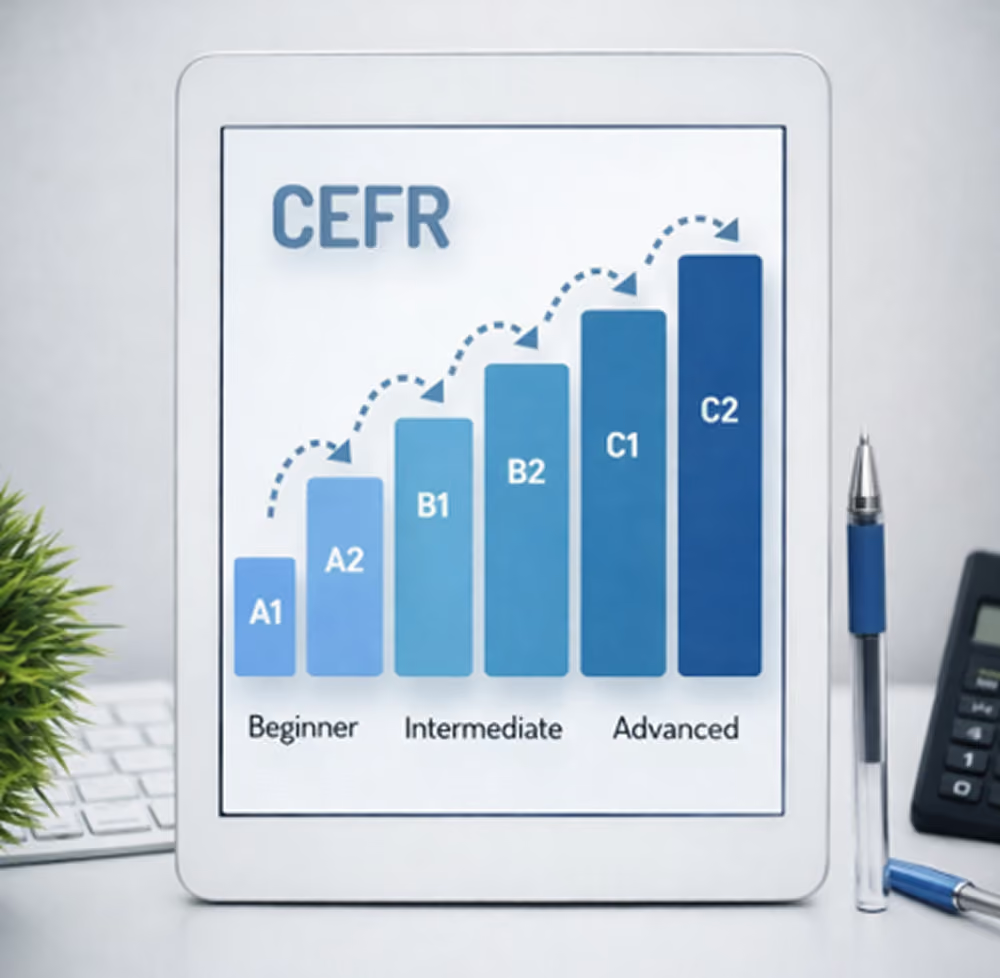
mYngle combines tailored course pathways with a structured, CEFR-aligned delivery model that personalises learning to job needs while keeping programme governance consistent at scale.
CEFR level matching from the start: Structured assessment places learners at the correct CEFR level, ensuring training begins at the right developmental stage and avoids misalignment.
Pathways aligned to workplace roles: Course options address both general communication and specialised professional needs, keeping learning directly relevant to day-to-day work contexts.
Flexibility within a coherent framework: Personalisation happens inside a defined programme structure, preserving consistency across teams while adapting to individual priorities and organisational goals.
Scalable outcomes and visibility for HR/L&D: Live online lessons and AI speaking practice support measurable progress, supported by feedback, checkpoints, and reporting for organisation-wide oversight.
For details on CEFR measurement and checkpoints, see the full CEFR alignment overview.
B) Learning Mechanisms

mYngle applies a communicative, task-based approach in live online language lessons so learning is centred on real professional interaction and practical workplace communication.
Task-based interaction increases meaningful speaking time: Learners complete authentic communication tasks that require purposeful language use and sustained participation. Tasks mirror real workplace situations and increase active speaking minutes.
Meaningful interaction supports adaptive learning: Live negotiation of meaning during sessions helps learners recognise communication gaps and adjust performance in real time with guidance from the teacher.
Integrated feedback improves clarity and accuracy: Teachers provide targeted corrective feedback during and after tasks to strengthen intelligibility, accuracy, and confidence in professional communication.
Outcome for HR and Learning and Development: Directly transferable communication skills that improve workplace performance.
For a full explanation of the communicative approach, see the detailed methodology page.

mYngle designs online language lessons to sustain motivation across the learning cycle and support steady long-term engagement.
Visible goals reinforce commitment: CEFR-aligned objectives provide a clear shared definition of progress. Measurable milestones make improvement visible and easier to sustain.
Real-time interaction supports engagement: Live online language lessons build human connection and active participation through continuous dialogue and guided interaction with the teacher.
Distributed practice supports continuity: Regularly spaced lessons create a stable rhythm so learners progress through natural plateaus without losing consistency.
Outcome for HR and Learning and Development: Higher completion rates and more reliable long-term development across teams.
For research details on motivation and persistence, see the evidence section.

mYngle accelerates language development by structuring online language lessons around active practice directly connected to professional communication needs.
One-to-one lessons maximise active minutes: Individual lessons increase the time learners actively produce language. Personalised guidance supports faster adjustment and targeted improvement.
Role-relevant topics increase transfer: Practice focuses on real workplace situations and familiar tasks, so learners apply new language immediately in their professional environment.
Retrieval-based practice strengthens retention: Active recall and repeated production strengthen durable access to language and support long-term fluency and confidence.
Outcome for HR and Learning and Development: Faster functional communication ability and more consistent application at work.
For a deeper analysis of rapid progress mechanisms, see the full progress overview.
C) Delivery and Programme Infrastructure

mYngle combines operational flexibility with structure so companies can deliver online language lessons globally while protecting continuity and accountability.
24/7 access removes time barriers: Learners can schedule online language lessons across time zones and realistic work calendars, keeping training accessible during changing professional demands.
Low-friction rescheduling preserves rhythm: Simple booking and rebooking reduce disruption and help learners maintain a steady cadence during busy periods.
Structure maintains accountability: Flexibility operates within defined goals and checkpoints. Teachers reinforce consistency and forward movement.
Outcome for HR and Learning and Development: Stable participation under variable workloads and scalable programme delivery.
For details on scheduling design, see the full overview of on-demand scheduling.

mYngle maintains teaching quality through structured teacher selection, professional development, and continuous monitoring to ensure consistent delivery standards.
Rigorous teacher selection ensures expertise: Teachers are selected through a multi-step evaluation of qualifications, adult teaching experience, and ability to teach effectively online.
Ongoing development sustains teaching quality: Teachers participate in training and feedback cycles designed to reinforce consistent delivery and continuous improvement
Performance monitoring maintains shared visibility: Learner feedback and lesson reviews feed into a formal quality assurance process, creating transparent oversight of teaching performance across regions and teams.
Outcome for HR and Learning and Development: Consistent teaching standards that support predictable outcomes and scalable programme delivery.
For a full description of teacher standards and monitoring, see the quality overview.

mYngle integrates learning analytics into online language lessons to connect training activity with measurable outcomes and support evidence-based decision-making.
Centralised analytics unify reporting: Engagement, attendance, utilisation, and progress data are captured in one reporting environment, creating a coherent and accessible overview of programme activity.
Real-time visibility supports early intervention: Continuous monitoring helps organisations detect participation risks and respond proactively so managers and HR can intervene during the learning cycle.
Outcome-based metrics clarify impact: Progress indicators link training activity to communication performance and support evaluation of effectiveness and investment value.
Outcome for HR and Learning and Development: Clearer ROI discussions, stronger budget control, and better targeting of support.
For the complete ROI framework and reporting model, see the analytics overview.

How mYngle Talk AI Speaking Practice supports teacher-led lessons and works as a standalone solution
mYngle Talk AI Speaking Practice is an AI speaking practice environment inside the mYngle platform. It is designed to strengthen spoken fluency and confidence through guided conversation practice. It can be used in two ways. It can complement teacher-led online language lessons by extending practice between lessons, and it can also be offered as a standalone product for learners who need flexible, on-demand speaking practice.
As a complement to teacher-led training, mYngle Talk AI Speaking Practice helps learners prepare for upcoming lessons, rehearse real workplace scenarios, and reinforce target language from lessons. It increases speaking time beyond scheduled lessons and supports faster automatic use of vocabulary, phrases, and structures.
It also helps learners overcome speaking anxiety by offering a safe environment to practice as often as needed. Teachers can assign speaking tasks aligned with course goals, so learners arrive at live lessons more confident and ready to focus on higher-value teaching and feedback.
As a standalone solution, mYngle Talk AI Speaking Practice provides an always-available fluency practice option for companies that want scalable speaking support without fixed schedules. Learners can practise workplace conversations at their own pace across levels and topics. This makes it useful for ongoing maintenance, onboarding programmes, and distributed teams that cannot easily commit to live lesson timetables.
Key Research Supporting mYngle Design

Instruction Effectiveness (Meta-analysis) — Norris, J. M., & Ortega, L. (2000). Effectiveness of L2 Instruction: A Research Synthesis and Quantitative Meta-Analysis. (ERIC record)
Instructed SLA Principles (Review) — Ellis, R. (2005). Instructed Second Language Acquisition: A Literature Review. (NZ Ministry of Education report; hosted on Stanford)
Corrective Feedback & Uptake — Lyster, R., & Ranta, L. (1997). Corrective Feedback and Learner Uptake: Negotiation of Form in Communicative Classrooms.
Corrective Feedback in Adult ESL — Suzuki, M. (Teachers College, Columbia University). Corrective Feedback and Learner Uptake in Adult ESL Classrooms.
Distributed / Spaced Practice (Meta-analysis) — Cepeda, N. J., et al. (2006). Distributed practice in verbal recall tasks: A review and quantitative synthesis. (PubMed record)
Spacing + Study Design (Gov practice guide) — Pashler, H., et al. (2007). Organizing Instruction and Study to Improve Student Learning. (Institute of Education Sciences, U.S. Dept. of Education)

CEFR Framework — Council of Europe (2001). Common European Framework of Reference for Languages (CEFR).
Frequently Asked Questions
How does learning work at mYngle?
mYngle combines assessment, active language use, distributed practice, teacher feedback, and measurable progression. These elements form a continuous cycle of practice, feedback, and improvement designed to support durable communication skills and measurable workplace outcomes.
What is mYngle and who is it designed for?
mYngle is a scalable provider of online language lessons for companies and professionals, built to improve workplace communication with measurable outcomes. It is designed for HR and Learning and Development teams that need consistent delivery at scale, and for employees and professionals who use a foreign language in meetings, presentations, customer calls, and written communication. mYngle supports any number of learners, from small teams to large multi-location rollouts.
How do mYngle online language lessons work?
mYngle online language lessons follow a structured cycle. Learners start with a CEFR-aligned assessment to confirm level and set workplace goals. They then join live online language lessons with teachers in one-to-one or small-group formats, focused on task-based practice and active speaking. Between lessons, learners build fluency with mYngle Talk AI Speaking Practice. Progress is reinforced through teacher feedback and tracked with checkpoints and reporting for HR.
How does mYngle differ from traditional language courses?
Traditional language courses often follow fixed schedules, generic syllabi, and limited measurement beyond completion. mYngle online language lessons are built for professional outcomes and programme governance. Training is CEFR-aligned, tailored to role-specific communication needs, and delivered through task-based practice for real workplace scenarios. Companies and professionals also get visibility into attendance, utilisation, and progress, and learners can increase speaking time through mYngle Talk AI Speaking Practice inside the platform.
How is learner progress measured in mYngle?
Learner progress in mYngle online language lessons is measured with CEFR-aligned checkpoints from A1 to C2 across speaking, listening, reading, and writing. Teachers provide structured feedback linked to job relevant goals, and reporting gives learners, managers, and HR a clear, comparable view of progress, engagement, and next steps across teams and locations.
How does mYngle support HR and learning teams?
mYngle supports HR and Learning and Development teams with scalable programme delivery, clear governance, and reporting. HR can monitor participation, utilisation, progress, and engagement signals across learners, teams, and locations. Real-time visibility helps identify risks early, reduce unused training spend, and improve completion. Reporting also supports internal stakeholder communication and ROI discussions.
What is mYngle Talk AI Speaking Practice and how does it support learning?
mYngle Talk AI Speaking Practice is an AI speaking practice environment inside the mYngle platform. It helps learners build fluency, confidence, and automaticity through guided conversation practice aligned with workplace scenarios. mYngle Talk AI Speaking Practice complements live online language lessons by increasing speaking time between lessons and helping learners arrive better prepared for teacher feedback. It can also be offered as a standalone fluency solution for companies and professionals that want flexible speaking practice without scheduled lessons.


.webp)